Recovering movement after a stroke
When a stroke has changed how someone moves, steady practice at home can help them rebuild it.
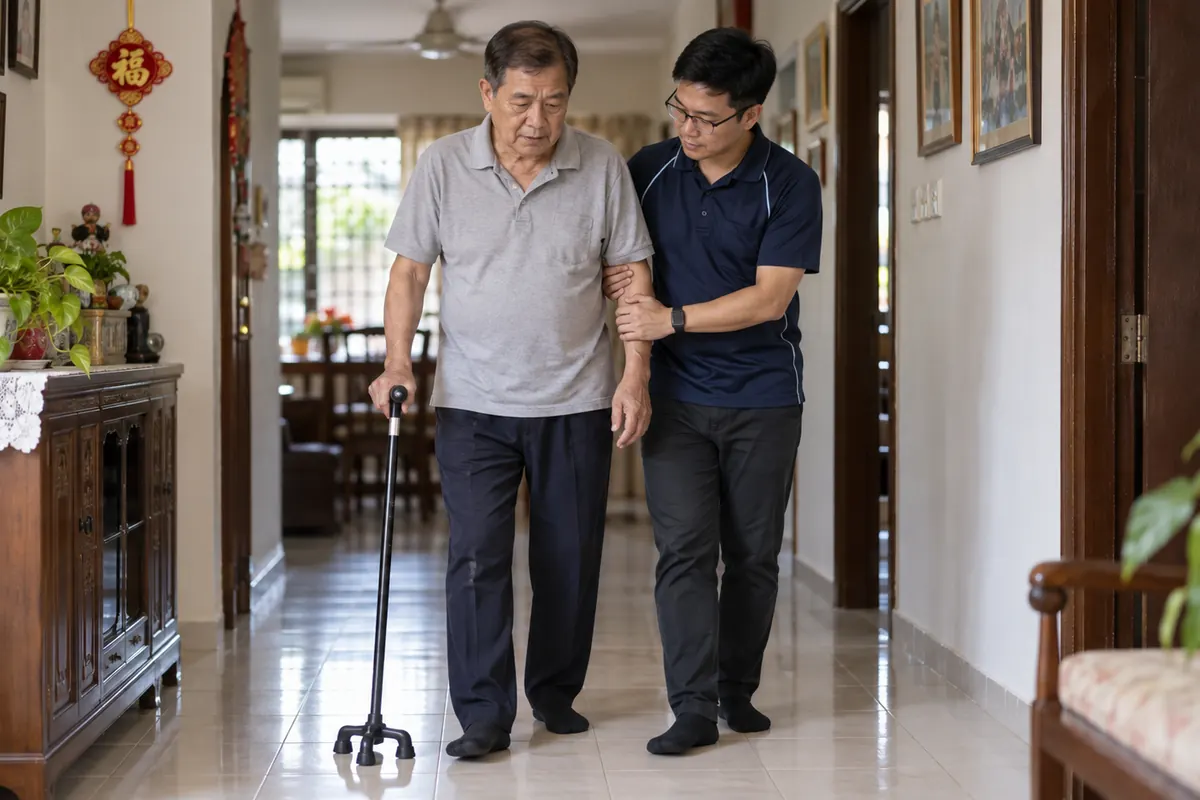
- Clinically reviewed content
- Home visits around Alor Setar, Sungai Petani and Kulim
- English and Bahasa Malaysia
- A quick reply on WhatsApp
What stroke rehabilitation at home means
A stroke can change how a person walks, stands, and uses an arm or hand. Stroke rehabilitation is the steady work of helping the body relearn those movements.
At home, this work happens in the rooms the person uses every day. A registered physiotherapist assesses what the person can do now, then rebuilds movement step by step.
The early months after a stroke matter most. Rehabilitation should start as soon as the person is medically stable, and starting while the body is still adapting gives the best chance to regain function.
What the first weeks usually look like
The first weeks focus on small, safe steps rather than big goals. A physiotherapist checks strength, balance and safety in the rooms the person uses every day.
Short, frequent practice suits this stage better than long, tiring sessions. Standing briefly, shifting weight, and small hand tasks are common starting points.
Progress can feel slow at first. That is expected, and each small gain still counts toward the next one.
Who benefits most from home stroke rehab
Home stroke rehabilitation suits survivors who have recently come home from the hospital. Travelling to a clinic can be tiring and unsafe in the early weeks.
It also helps people who have weakness on one side, trouble standing, or difficulty moving from bed to chair. Families who want to learn how to help safely gain a lot from it too.
If the person is medically stable but simply cannot travel, home is often the calmer place to start.
Retraining walking, standing and arm use
Much of the work is practising the movements that daily life needs. We work on standing safely, shifting weight, and taking steps with support.
Many survivors also have spasticity, which means certain muscles become tight and hard to control. We use gentle stretching and good positioning to ease that tightness and keep joints moving.
Arm and hand use is practised with real tasks, such as reaching, holding and letting go.
Simple changes to the home also support practice. A stable chair, a clear path to the bathroom, and good lighting reduce the chance of a fall. Equipment such as a walking frame or a grab rail is suggested only when it is genuinely needed, and the physiotherapist explains why before it is added.
What a visit does, and teaching the family
The first visit is an assessment of movement, safety and the family’s main goals. From there the physiotherapist sets a small number of clear targets.
Each session builds on the last. A large part of every visit is teaching the caregiver, especially safe transfers: how to help the person move from bed to chair without hurting either of them.
Simple reminders are left so the family can practise between visits. People who can move from bed to chair independently or with assistance, in a safe home, are often good candidates for this kind of early home-based support.
What the family does between visits
Getting family and friends involved can help recovery, and the caregiver’s role is central to home rehabilitation. Between visits, the caregiver keeps practising the routines the physiotherapist has shown, especially safe transfers and positioning.
Small daily habits matter more than occasional long sessions. A short, safe walk to the bathroom is real progress, even if it looks ordinary.
The caregiver is never left to guess. Each visit includes time to ask questions and adjust what is being practised at home.
How this links with hospital follow-up in Kedah
Home rehabilitation works alongside hospital care, not instead of it. An efficient referral and rehabilitation network between hospital stroke care and community follow-up is part of what makes stroke services work well.
We encourage families to keep every hospital appointment, whether at Hospital Sultanah Bahiyah or another facility in Kedah. If it helps continuity of care, we are glad to share what we observe with the treating doctor.
When a hospital rehabilitation ward is better
Home rehabilitation is not always the right first step. Some survivors need the close medical support of a hospital rehabilitation ward first.
When there is sudden new weakness, a very recent stroke that is still unstable, or other conditions that need daily monitoring, the ward comes first. Intensive daily therapy with specialised equipment can also suit the earliest stage.
We are glad to help you judge which step fits before you commit.
Questions worth asking early
A few useful questions help a family plan. What does a realistic first month usually involve? What signs mean the person should go back to hospital?
How will we know progress is happening, even when it feels slow? What can the family safely practise alone, and what should wait for a supervised session? We answer these at the first assessment, based on what we actually see.
If a stroke has recently changed how someone in your family moves, send us a short message about their situation and we will explain where home rehabilitation could help.
Common questions
When should stroke rehabilitation start?
As soon as the person is medically stable, gentle rehabilitation can begin, often soon after discharge. The early months are when the body adapts most, so starting sooner helps. After the first assessment we explain a realistic pace, and we never push harder than the person can safely manage.
Will my family member fully recover after a stroke?
Every stroke is different, so we cannot promise a set outcome. What rehabilitation does is help the body relearn movement and rebuild strength and confidence over time. Many people regain real independence with steady practice. After assessing, we explain realistic goals for your family member rather than a fixed result.
What is spasticity and can it be helped?
Spasticity is when certain muscles stay tight and hard to control after a stroke. It can make an arm or leg feel stiff. Gentle stretching, good positioning and regular movement help ease it and keep the joints mobile. We show the caregiver how to do this safely between visits.
Which areas of Kedah do you cover for stroke rehab?
We visit homes within about 30km of Alor Setar, Sungai Petani and Kulim. We do not cover Langkawi. Tell us where the person lives on WhatsApp and we will confirm whether a home visit fits their situation.
What does a typical first month of home rehab look like?
The first month usually focuses on small, safe steps rather than big goals. A physiotherapist checks strength, balance and daily safety, then builds short, frequent practice around what the person can already do. Progress can feel slow at first, and that is normal.
Do we still need to attend hospital follow-up appointments?
Yes. Home rehabilitation works alongside hospital follow-up, not instead of it. We encourage families to keep every appointment, and we are glad to share what we observe with the treating doctor if that helps.
Sources
- WHO states stroke rehabilitation should begin as soon as the person is medically stable, ideally within the first few days. WHO, Stroke fact sheet (2026-09)
- NICE guideline NG236 supports early supported discharge for people who can move from bed to chair independently or with assistance, in a safe environment. NICE NG236, Stroke rehabilitation in adults (2026-09)
- NHS guidance notes that getting family and friends involved can help stroke recovery, and caregivers are a big part of that recovery. NHS, Stroke recovery (2026-09)
- Malaysia's clinical practice guideline on ischaemic stroke states that an efficient referral and rehabilitation network is needed for stroke units to succeed, since organised multidisciplinary stroke unit care reduces death and dependency. Malaysian Society of Neurosciences, CPG Management of Ischaemic Stroke (2026-09)
If a stroke has recently changed how someone in your family moves, send us a short message about their situation and we will explain where home rehabilitation could help.