Physiotherapy for women's health and postnatal recovery
For pelvic floor concerns and postnatal recovery, a physiotherapist can assess and guide you in your own home.
- Clinically reviewed content
- Home visits around Alor Setar, Sungai Petani and Kulim
- English and Bahasa Malaysia
- A quick reply on WhatsApp
What women’s health physiotherapy covers
This covers pelvic floor and core concerns. It includes those that follow pregnancy and birth, such as leaking with coughing or exercise, a feeling of heaviness, or back and pelvic pain that has not settled.
A physiotherapist assesses how these muscles are working. From there, we build a plan of exercise and guided technique around what you actually need. Supervised pelvic floor muscle training is recommended as a first-line option for women with stress or mixed urinary incontinence.
How this is different from confinement massage
Confinement and postnatal massage is a valued tradition, but it is a different modality, and we do not offer it.
Physiotherapy is a clinical assessment of muscle function and movement, delivered by a registered physiotherapist. It works toward specific goals, such as symptom relief and a safer return to daily activity or exercise.
If what you are looking for is massage, we will say so and are not the right fit.
What a home assessment involves
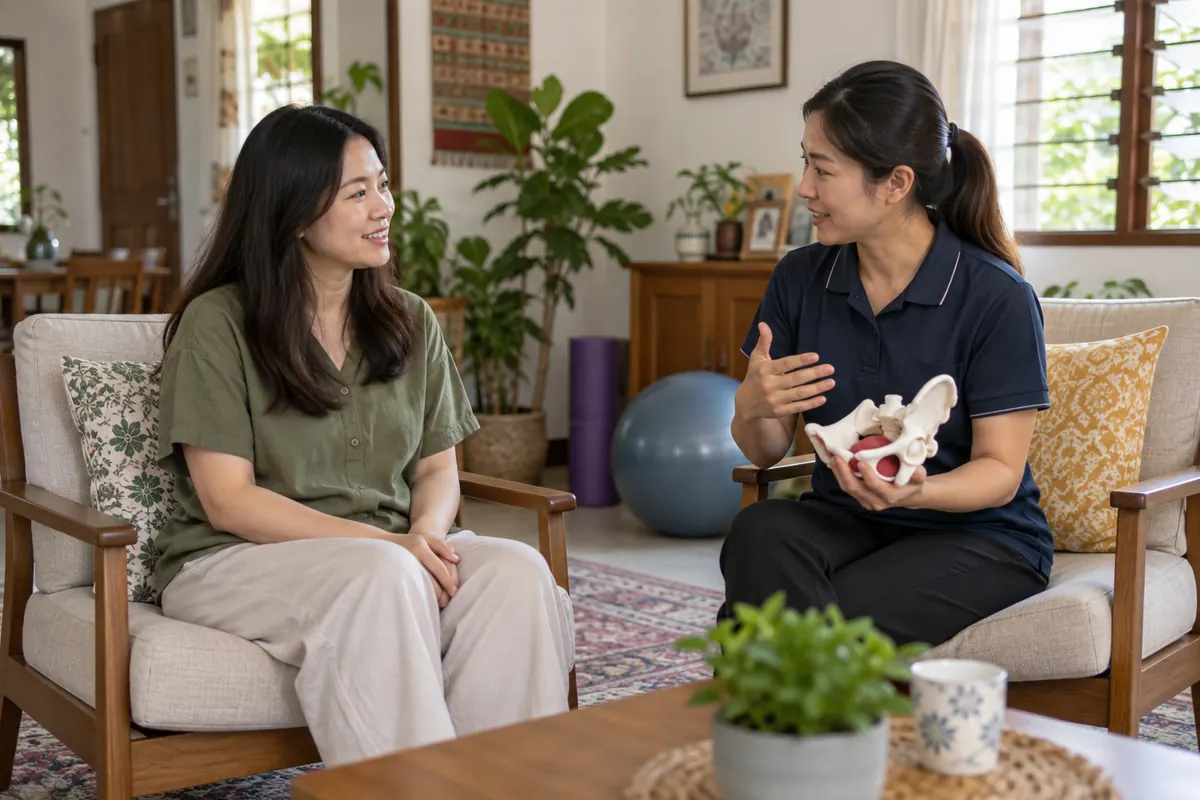
The first visit is a conversation about your history, your delivery if relevant, and what you are noticing now. Some assessment may involve gentle physical checks. These are always explained first, and only done with your consent.
From there, the plan usually starts gently: breathing and pelvic floor coordination. It builds strength and control as your body allows.
You are always in control of what happens during a visit. If something does not feel right, or you would prefer to stop, that is respected without question.
When to see a doctor first
Some symptoms need a doctor’s review before physiotherapy, including heavy bleeding, signs of infection, or pain that is severe or sudden. We ask about these first and will point you to the right care if anything raises concern.
If exercise alone does not resolve your symptoms after a reasonable trial, that is also worth discussing, since some situations need further medical assessment rather than more exercise.
Questions worth asking early
A few useful questions help you plan. How long is a realistic trial of exercise before we know if it is helping? What symptoms mean I should see a doctor sooner rather than wait?
What can I safely do at home between visits, and what should wait until we have checked technique together? We answer these at the first assessment, based on what you are actually experiencing.
Returning to daily life and exercise
For many women, the goal is a safe, confident return to daily tasks, lifting, or exercise, without pain or leaking holding you back.
Progress is usually gradual and reviewed at each visit, built around your body’s own pace of recovery. Some women aim to return to running or gym training, while others simply want to lift their child without discomfort. Both goals are treated as equally valid.
How progress is checked over time
A structured programme takes time to show results. A supervised pelvic floor muscle training programme is often followed for several months, or even longer for symptoms like heaviness from prolapse, with technique checked regularly along the way.
At each visit, a physiotherapist checks how the muscles are responding, not just whether the exercises are being done. Small, steady improvements matter more than a single big change.
If something is not working as expected, we say so and adjust the plan or discuss what else might help.
We would rather tell you that a plan needs adjusting than let you keep doing something that is not actually helping.
What the family and daily routine can support
A partner or family member cannot do these exercises for you, but a supportive routine at home helps. A quiet few minutes without interruption makes technique easier to get right, especially in the early weeks after birth when the household is often busy and unpredictable.
Everyday habits, such as good posture when lifting a baby or carrying groceries, also support the muscles being retrained. A physiotherapist can talk through these small adjustments during a visit.
If you are recovering after birth or have a pelvic floor concern, message us your situation and we will explain what an assessment would involve.
Common questions
What does a postnatal physiotherapy assessment cover?
It looks at pelvic floor and core strength, how your body is recovering after birth, and any specific concerns such as leaking, heaviness, or back and pelvic pain. From there we build a gentle, realistic plan, adjusted to how you are healing.
Is this the same as confinement or postnatal massage?
No. Confinement and postnatal massage are a different tradition and modality, which we do not offer. Physiotherapy assesses muscle function and movement and uses exercise and guided technique, delivered by a registered physiotherapist.
How soon after birth can I start?
It depends on your delivery and recovery, and on what your doctor has advised. We ask about this first. For many women a gentle start is possible early on, with the plan building up as healing progresses.
Do you treat pelvic floor concerns outside of pregnancy too?
Yes. Pelvic floor and core concerns are not limited to the postnatal period, and we are glad to discuss your situation, whatever the cause.
How long does pelvic floor training usually take to show a difference?
It varies, but a structured programme is usually followed for several months before judging results, with technique and consistency checked along the way. We review progress at each visit rather than promising a fixed timeline.
What happens if symptoms don't improve with exercise alone?
We say so and discuss what may be needed next, which could include a referral back to your doctor for further assessment. Not every case resolves with exercise alone, and we would rather be upfront about that.
Sources
- NICE guidance recommends offering a trial of supervised pelvic floor muscle training, of at least 3 months, as a first-line option for women with stress or mixed urinary incontinence. NICE NG123, Urinary incontinence and pelvic organ prolapse in women (2026-09)
- NICE guidance also recommends a programme of supervised pelvic floor muscle training, of at least 16 weeks, as a first option for symptomatic pelvic organ prolapse at an early stage. NICE NG123, Urinary incontinence and pelvic organ prolapse in women (2026-09)
If you are recovering after birth or have a pelvic floor concern, message us your situation and we will explain what an assessment would involve.